

This is my review of Shane Gibson‘s book, An Agile Data Guide to Information Product Canvas, published in May 2025. In short, this book is a valuable addition to any data practitioner’s bookshelf because it provides easy-to-consume advice about a valuable data requirements technique. Interestingly, this book offers several interesting dichotomies:
- Due to its focus on an artifact (information product canvas), it is applicable to teams following an agile way of working (WoW), as well as teams with a traditional WoW (heresy, but I said it!)
- Due to its visual presentation, it is light on text yet heavy on valuable advice
- Due to its focus on proven and pragmatic patterns, it is a quick read yet long-term reference
What is an Information Product Canvas?
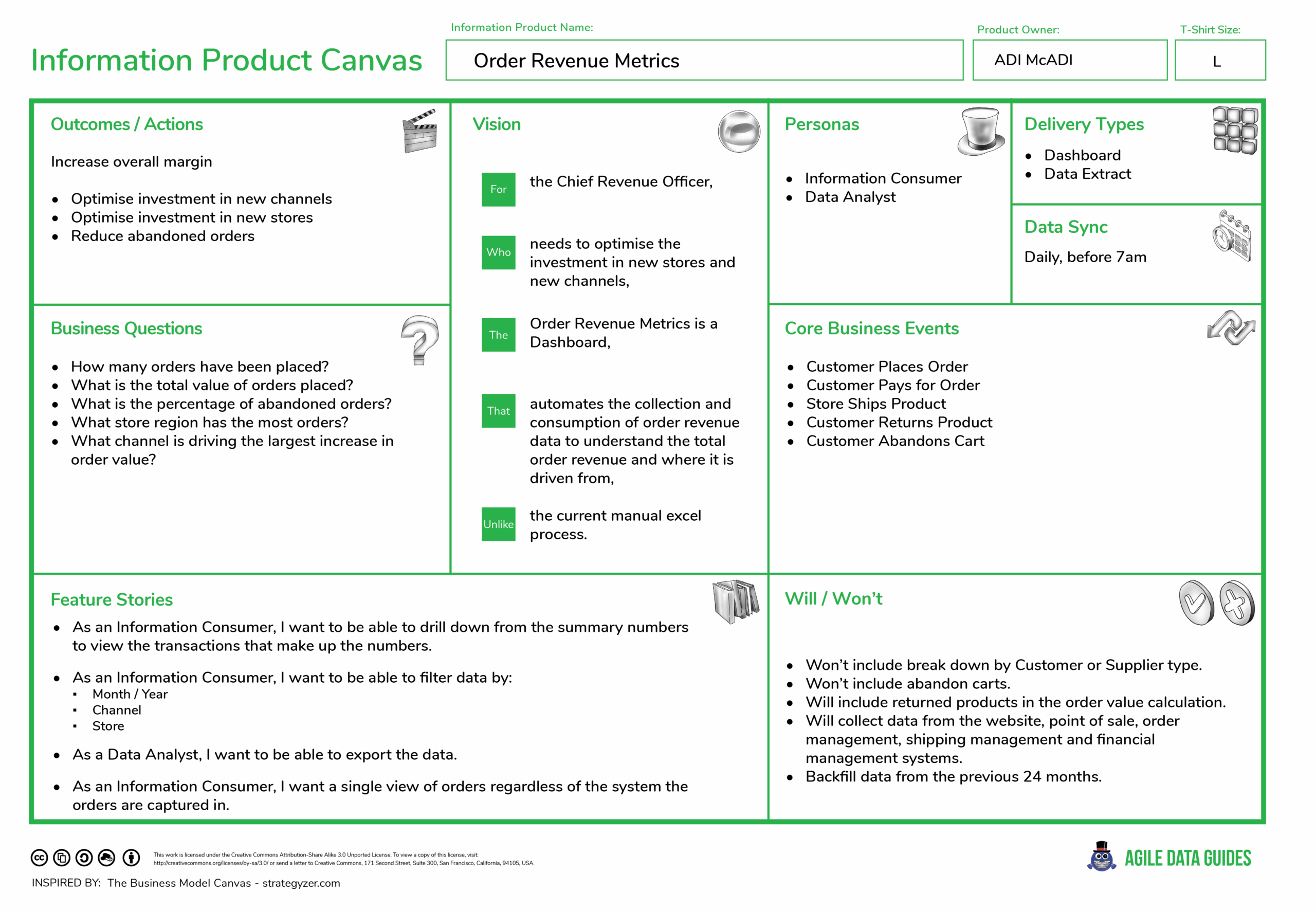
An information product encapsulates data, code, and analytics. It delivers information visually to enable actions and outcomes that drive organizational value. An information product canvas (see the following example) is a template for quickly capturing data and information requirements.
I see information product canvases benefitting three groups within your organization:
- Stakeholders. Stakeholders can easily understand information product canvases because they are straightforward, making them inclusive. This offers the potential for effective requirements elicitation through active stakeholder participation.
- Development teams. An information product canvas provides a great starting point for a team building an information product.
- Leadership. An information product canvas provides a comprehensive, straightforward summary of an information product that covers the key topics required to govern its development.
I also believe that this book will benefit data teams following either an agile or a traditional approach, or even a lean/continuous delivery approach, for that matter. The book clearly focuses on agile WoW around the development of an information product canvas, and many of these techniques could be applied in traditional settings, giving you a hybrid WoW in effect. Even if you don’t do that, all of the material describing each section of the canvas, as well as the numerous example canvases, is clearly paradigm agnostic.
A Visual Description
The book is organized as a series of two-page spreads, each covering a concept or pattern. Most spreads include a visualization, which could be a descriptive graphic or an example canvas (see above), occupying most of the left-hand page. The right-hand page contains text providing an overview of the topic. Sometimes a topic is described without a visualization, occurring (perhaps) 20% of the time. The visual, two-page spread for a topic makes them easy to understand and then reference later.
An important feature of the book is that it includes a range of example canvases from different domains, including, but not limited to, software-as-a-service, insurance, consumer goods, social housing, and automotive. If the visual descriptions of how to write your own canvas aren’t enough (they likely are), the provided visual examples will definitely answer any questions you may have.
Proven and Pragmatic Patterns to Create an Information Product Canvas
Each pattern, and to be clear, Shane applies a very liberal definition to the concept of patterns (which I agree with, although pattern purists may not), is presented visually as a two-page spread. They fit together into a coherent way of working (WoW) for applying information product canvases in practice. The pattern purists would call this a pattern language.
The important thing is that these patterns have been proven in practice by Shane applying them with customers, many of them originate from other practitioners who have also applied them in practice. The bottom line is that these practices are not only pragmatic, they are also likely to be familiar to you and may even have been applied by you at some point. The value of this book is how Shane has curated and described these strategies in a very consumable manner.
Disclaimer and Not-So-Subtle Brag
I’ve had the pleasure of knowing Shane and have been following and leveraging his work for many years now. When he was writing this book, he asked me to contribute some advice, Craft Your Own WoW, based on material from Choose Your WoW! by Mark Lines and myself. This appears at the start of the “Continue Your Journey” section on pages 182-183. It was an honour to contribute to this great book.
Where to Get An Agile Data Guide to Information Product Canvas